
They provided risk projections for managers to choose, the chosen 20% TAC reduction yields 0% probability of overfishing
Under the 2020 ERP definitions, Atlantic menhaden are not overfished and overfishing is not occurring. For 2023, fecundity is on the order of 1.2 quadrillion eggs (above the ERP fecundity threshold but below the target) and fishing mortality is about 0.26 (above the ERP F-target but still below the ERP F-threshold). The overview also makes clear there is no single "right" ERP; selecting ERP targets and thresholds is a management choice that balances objectives for menhaden and their predators.
The 2025 single-species update applied a lower estimate of natural mortality (M). That change lowers the back-calculated biomass, fecundity, and recruitment across the time series and raises the corresponding fishing mortality (F) estimates, even though the underlying population did not suddenly decline. Because of the revised M, the 2025 assessment's long-term average biomass is about a third lower than the 2022 update's average; this reflects an improved understanding of the stock rather than a real-time drop in the stock itself.
The 2025 update shows that the biomass of age-1+ menhaden is just below its 20-year average but has been trending up since 2021.
Adult abundance in 2023 was 14.8 billion age-1+ fish, above the average of the past 20 years.
Recruitment in 2023 was 44.5 billion age-0 fish, above the average of the past 20 years.
WASHINGTON, DC / ACCESS Newswire / December 2, 2025 / In the weeks since the 2025 ASMFC Annual Meeting, there's been a widespread misconception circulated by environmental and recreational fishing groups that the ASMFC Menhaden Board's technical and scientific advisors "recommended" a 50% or 54% cut" (to 108,450 mt) to the Atlantic menhaden total allowable catch (TAC), and that the Commission ignored those recommendations. That is not the case. Rather, scientists ran a set of "if-then" scenarios for managers. There were no recommendations of preferred TAC made. The Technical Committee and the ERP Working Group supply projections and risk information; the commissioners decide policy.
The American Sportfishing Association (ASA), in an article by Rob Shane titled "Mixed Results from 2025 ASMFC Annual Meeting," states that "recent peer-reviewed science recommended a 54% quota cut" for Atlantic menhaden.
The National Marine Manufacturers Association (NMMA) press release "Atlantic States Marine Fisheries Commission's Annual Meeting Ends with Mixed Results for Recreational Anglers" similarly says the Board implemented only a 20 percent reduction "despite peer-reviewed research recommending a 54% cut to the commercial quota".
The Theodore Roosevelt Conservation Partnership has repeatedly asserted that "slashing the coastwide catch limit by more than half" or "more than 50 percent" is needed to follow the science in "Menhaden Stock Assessment Indicates Catch Must Be Reduced to Benefit Striped Bass" and again in "Marine Fisheries Board Declines to Make Science-Based Reduction to Atlantic Menhaden Catch Limit" .
The American Saltwater Guides Association went further, urging "massive reductions" and telling readers that "the bottom line is we need a 55% reduction in the TAC for Atlantic menhaden" in "Take The Cut: Massive Reductions for Menhaden Industry Necessary").
The Chesapeake Bay Foundation, in a press release by Vanessa Remmers titled "Menhaden Management Meeting Results in Lackluster Coastwide Catch Reductions" , told supporters that "The ASMFC menhaden stock assessments resulted in forecasts indicating the need for a 54 percent cut to the menhaden harvest to meet the needs of predators like striped bass, osprey, and marine mammals."
Jim McDuffie, President and CEO of Bonefish and Tarpon Trust, in a press statement said: "While today's vote resulted in a 20% reduction, it was far short of the reduction recommended by the Commission's own scientists.
The International Game Fish Association inaccurately stated in a press release that "scientists said that a quota of 108,000 MT was necessary to have a 50% chance of success of rebuilding the striped bass fishery."
Sport Fishing magazine amplified the same narrative, reporting that ASMFC "implemented a 20 percent cut to the Atlantic commercial menhaden harvest, when peer-reviewed science recommended a 54 percent quota cut, according to an ASA press release" in Nick Carter's "Anglers Frustrated with Menhaden Management".
A Washington Post guest essay "It's the ‘most important fish in the sea.' And it's disappearing." by Mark Robichaux, framed the controversy around the idea that managers failed to adopt the deep cuts "scientists recommend" to protect striped bass and other predators (Washington Post Opinions: Guest Opinions, Nov. 20, 2025 - a full-text mirror is here.
A thorough review of all the meeting materials and reports, and of the entire recording of the meeting available online, shows there is nowhere where the Technical Committee (TC) or the ERP Working Group "recommends" a 54% cut, or any specific TAC. Staff consistently present options and risks at the Board's request, not a recommendation. The only time a 54% cut is presented as a recommendation is when Commissioner Matt Gates of Connecticut incorrectly described the option provided at the Board's request as a recommendation. His motion reads: "I would like to make the motion for the TAC recommended in the TC and working groups memo that achieves a 50% probability of achieving the ecological reference point F target… move to set the TAC… at 108,450 metric tons…."
The TC and Working Group staff members produced exactly what the Board asked for. At the Spring 2025 meeting of the Menhaden management board, "The Board requested the projections include the TACs associated with a 40-60% probability of exceeding the ERP F target for 2026-2028 combined and as separate years, and the percent risk of exceeding the ERP F target and threshold for nine different TACs ranging from -20% to +20% of the current TAC in 5% increments when it considers specifications for the next one to three years at the Annual Meeting." (2025 Spring Meeting Summary p.15).
This request resulted in tables showing TAC options tied to specified probabilities of exceeding the ERP F-target (and the chance of exceeding the overfishing threshold) across TACs. Those summary tables were explicitly referenced during debate as "tables four and five… PDF pages 68, 69 of the board material." Those tables included all the projections requestedincluding the TACs associated with a 40-60% probability of exceeding the ERP F target for 2026-2028 one of which was the projection for a TAC of 108,450. None of those projections were "recommended"
Responding to what they referred to as "a lot of stakeholder discussion," including the false claim that the biomass decreased, the ASMFC issued a fact-check "FAQ" shortly after the meeting noting that what changed was the understanding of natural mortality - how many fish die in a year - not the size of the stock.
"The difference in the population estimates from the 2022 and 2025 assessments is primarily due to a change in the estimate of natural mortality, which affects our estimates of the overall size of the stock. .... The average menhaden biomass over the whole time-series [since 1955] from the 2025 assessment update is 37% lower than the average biomass from the 2022 update. However, the 2025 update indicates total biomass has slightly increased since 2021. The lower estimate of biomass from the current assessment compared to the previous assessment is a result of a change in our understanding of the stock rather than a change in the stock itself." (ASMFC, November 2025, Menhaden FAQ)
Several recreational and environmental groups criticized the consideration of economic factors and potential job loss in the decision made by the Menhaden Management Board. This ignores the fact that Section 6(a) of the Atlantic States Marine Fisheries Commission Interstate Fisheries Management Program Charter requires that social and economic factors be considered.
"The Commission recognizes that an effective fishery management program must be carefully designed in order to fully reflect the varying values and other considerations that are important to the various interest groups involved in coastal fisheries. Social and economic impacts and benefits must be taken into account (ASMFC, 2019, ISMFP Charter)
This analysis examines what actually happened in the meeting, and reviews what the Technical Committee and ERP Working Group actually did and said. These are the documents and recordings used in the preparation of this analysis, and we invite any journalist, scientist or member of the public to review the documents and our analysis for factual accuracy.
Atlantic States Marine Fisheries Commission. (2025, May). 2025 spring meeting summary. https://asmfc.org/wp-content/uploads/2025/05/2025SpringMeetingSummary.pdf
ASMFCvideos. (2025, October 31). Atlantic Menhaden Board Proceedings October 2025 [Video]. YouTube. https://www.youtube.com/watch?v=wNB2rnpoqJc
Atlantic States Marine Fisheries Commission. (2025, November). 2025 Atlantic menhaden single-species assessment update (October 2025). https://asmfc.org/wp-content/uploads/2025/11/2025AtlMenhadenSingleSpeciesAssmtUpdate_October2025.pdf
Atlantic States Marine Fisheries Commission. (2025, November). Menhaden FAQ (October 2025). https://asmfc.org/wp-content/uploads/2025/11/Menhaden-FAQ-Oct2025.pdf
Atlantic States Marine Fisheries Commission. (2025, November). Atlantic menhaden assessments overview (October 2025) [Word document]. https://asmfc.org/resources/stock-assessment/overview-of-atlantic-menhaden-assessment-update-erp-benchmark-stock-assessment-2025/
Atlantic States Marine Fisheries Commission. (2020, February). Atlantic Menhaden Board proceedings (February 2020). https://asmfc.org/wp-content/uploads/2025/02/AtlMenhadenBoardProceedingsFeb2020.pdf
Atlantic States Marine Fisheries Commission. (2019, August). Interstate Fisheries Management Program (ISFMP) charter. https://asmfc.org/wp-content/uploads/2025/01/ISFMPCharter_Aug2019-2.pdf
We express our appreciation to the ASMFC for issuing the above-referenced Menhaden FAQ and Atlantic Menhaden Assessments Overview to address misunderstandings of the findings of the single-species assessment update and Ecological Reference Point Benchmark Stock Assessment, as well as the Board's response to the assessments' findings.
What happened in the meeting
During the meeting neither the Technical Committee (TC) nor the ERP Working Group members or staff recommend a specific TAC. In the meeting, the representatives repeatedly framed their role as providing the projections the Board asked for so commissioners could choose their acceptable risk. Ms. Caitlin Craig, Chair, Menhaden Technical Committee, explained this work was performed at the Board's direction: "At the spring meeting, the board requested that the projections include the TACs associated with a 40 to 60% probability of exceeding the ERP target… and then the percent risk of exceeding the ERP target and threshold for nine different TACs ranging from negative 20% to positive 20% of the current TAC…." She reminded commissioners "In setting TAC, the board should consider what level of risk they are willing to accept."
Technical Committee (TC) members and staff also explained exactly how to read the tables, again, as options the Board could pick from, not recommendations. Ms. Craig told the Board, "You would pick the TAC that would result in no more than X percent probability of exceeding the F target in any year… and the 50 percent probability… is bolded for reference." In the same presentation, she reiterated these were the "scenario runs that were requested by the board," after which "we'll present the table of results of all the scenarios." Commissioners themselves pointed to the packet tables as reference material, "tables four and five in the projections memo… PDF pages 68, 69 of the board material", further underscoring that staff were furnishing information, not prescribing an action.
The only place staff used "recommend" in this meeting was about which model to use for developing advice, not about any TAC. Dr. Matt Cieri, Marine Scientist, Stock Assessment Subcommittee, reviewed model choices and said the NWACS-MICE "is the model that we're recommending for developing management advice," and described other models as not recommended or only for support.
Against that backdrop, when Commissioner Gates of Connecticut, made his motion and referred to the "TAC recommended in the TC", he misspoke. The meeting recording shows the TC did not recommend a TAC; they provided risk-based choices including the 50% option.
Put simply: the TC and Working Group supplied a menu of TAC options and the associated probabilities the Board requested; they did not tell the Board which TAC to choose. Commissioner Gates' phrasing ("TAC recommended…") does not match what staff said or did in the meeting record.
The ERP toolkit, NWACS-MICE alongside the single-species BAM model, lets managers and stakeholders weigh trade-offs between menhaden harvest, predator harvest, and resulting predator biomass to set final ERP targets/thresholds and, from there, the TAC. The familiar "rainbow" surface plot is simply a visualization of those trade-offs: if striped-bass F rises, menhaden F typically must fall to deliver the same striped-bass biomass outcome, and vice versa.
Ms. Caitlin Craig, Chair, Menhaden Technical Committee, framed choices and risk tolerance
Ms. Craig opened the projections item by reiterating how TACs are set and where the Board's judgment comes in: "the board has used the best available science… In setting TAC, the board should consider what level of risk they are willing to accept." She immediately linked the analysis to prior Board direction: "At the spring meeting, the board requested that the projections include the TACs associated with a 40 to 60% probability of exceeding the ERP target… and then the percent risk of exceeding the ERP target and threshold for nine different TACs ranging from negative 20% to positive 20% of the current TAC…."
To help commissioners use the packet, Ms. Craig explained, "you would pick the TAC that would result in no more than X percent probability of exceeding the F target in any year… and the 50 percent probability… is bolded for reference," and reminded them these were "scenario runs that were requested by the board," followed by a table "of all the scenarios." During debate, packet locations were cited, "tables four and five in the projections memo… PDF pages 68, 69 of the board material", underscoring these were reference materials, not prescriptions.
Why it matters: Staff plainly presented options with associated probabilities and told the Board to choose its acceptable risk; that is not a staff TAC "recommendation."
Dr. Katie Drew, Stock Assessment Scientist, Stock Assessment Subcommittee, ASMFC staff, explained ERPs are long-term reference points; striped bass are being fished below F-target while rebuilding
Dr. Drew clarified that ERP tools are "at equilibrium" and not designed for short-term status triggers: "This isn't short-term sort of decision-making. And that's why the ERPs are designed to be your reference points, not your stock status determination criteria." She detailed why striped bass must be fished more conservatively while rebuilding: "we actually have to fish them… below their F target… we have a deadline of 2029… your F rebuild can be different than your F target."
On current conditions, Dr. Drew added: "Right now we are, for menhaden, we're a little bit above that fecundity threshold. So that suggests that there is currently enough menhaden to sustain striped bass where they are right now… The fishing mortality on striped bass is lower in 2024 and probably 2025 below that F target."
Why it matters: If ERPs are long-term tools and striped bass are being fished below their F-target during rebuild, a one-year 54% menhaden cut aimed at the ERP F-target would have been a policy choice, not a scientific requirement to prevent overfishing.
Dr. Matt Cieri, Marine Scientist, Stock Assessment Subcommittee, showed multiple pathways to the striped-bass goal; model recommendation was about methods, not TACs
Dr. Cieri walked commissioners through the "rainbow plot," emphasizing there are many menhaden/striped-bass F combinations that reach the striped-bass objective: "there's many different combinations of striped bass F and menhaden F… that can get you to your goal of striped bass… at its target or above. Higher menhaden Fs require, therefore, lower striped bass Fs and vice versa." He noted striped-bass F was already reduced in 2024 and that holding both species at those equilibrium Fs would place "striped bass… at its target or above."
He also reiterated control-rule definitions: an ERP "target… allows striped bass to stay at their biomass target when striped bass are fished at their F target… You can also define an ERP threshold… that keeps striped bass at its threshold when fished at its target." Regarding methods, he said the NWACSMICE model "is the model that we're recommending for developing management advice," while other models were not recommended or only for support.
In implementation, NWACS-MICE is used together with BAM to translate ERP risk choices into an annual TAC and to check status relative to ERP targets and thresholds. The "rainbow" surface plot visualizes those trade-offs; if striped-bass F goes up, menhaden F generally must come down to reach the same striped-bass biomass outcome (and the reverse is also true).
Why it matters: The "recommendation" language was about modeling tools, not a TAC. And the trade-off plot shows a spectrum of viable TAC choices depending on striped-bass fishing policy, again, options, not a mandate for a 54% cut.
Ms. Craig read the headline probabilities into the record; staff later "filled the gap" with 30% and 40% cuts, still 0% overfishing risk
On status-quo TAC, Ms. Craig reported "100% probability of being above the F target and a 4% chance of exceeding the F threshold by 2028," plus "50% probability of being below the fecundity target and an 8% chance of being below the fecundity threshold." She described the "50%-probability" band as "108,450… to 124,800 metric tons… 50% probability of exceeding the ERP F target and a 0% probability of exceeding the F threshold." She then walked the Board through how to use the table: "you would pick the TAC that would result in no more than X percent probability of exceeding the F target… the 50 percent probability… is bolded for reference."
At commissioners' request to "fill the gap" between tables, staff presented additional slides: for a 30% reduction, "0% probability of exceeding the F threshold across all three years," and for a 40% reduction, "again, a 0% probability of exceeding the F threshold… [with] the probability of falling below the ERP fecundity threshold… about 1 or 2%." Ms. Craig also noted: "in some scenarios, striped bass can rebuild above their SSB target even under higher levels of menhaden F."
Why it matters: Even 30-40% cuts have 0% overfishing risk; the issue is how much extra risk reduction the Board wants relative to the target. The threshold (overfishing line) wasn't being crossed in these scenarios, underscoring that a 54% cut was not biologically necessary to avoid overfishing.
What the adopted 20% reduction does (and how it compares), Mr. Joe Grist, Commissioner, Virginia
When Mr. Joe Grist made the motion for a 20% reduction, he framed it as a balanced policy choice. He underscored the stock's assessment pedigree and status: "Overfishing is not occurring. The stock is not overfished. Both the single species assessment and ecosystem assessment have passed the peer review for this."
He then read the projection results into the record to show why a 20% reduction was sufficient on biological risk: "the proposed TAC is associated with a 0% probability of exceeding the ERP fishing mortality threshold in 2026 through 2028, and a low 2% to 4% probability of falling below the ERP fecundity threshold during the same period." For packet navigation he added, "For reference, you can see tables four and five in the projections memo or the PDF pages 68, 69 of the board material."
Mr. Grist also described the federal risk-policy context and contrasted the 20% motion with the ~54% ("50%-to-target") option: even at ~54%, the fecundity-threshold probabilities would be "2% in 2026… and 1% in 2027 and 2028, which is only a 3% change from the 20% [reduction]."
Finally, he described the socioeconomic stakes and his intent to balance them with ecological risk: "To reduce any further than 20%… [would] put at risk directly or indirectly, hundreds if not thousands of American jobs across several states. It will also result in the decrease of supply and increase in… prices… This motion is made to balance the ecological concerns as well as the socioeconomic issues…."
Why it matters: The adopted TAC (−20%) yields 0% probability of overfishing (ERP F-threshold) and nearly identical fecundity-threshold risk to a ~54% cut, while avoiding disproportionate socioeconomic harm. That is consistent with Dr. Drew and Dr. Cieri's explanation that ERPs are long-term tools and multiple policy paths exist to achieve striped-bass objectives. The consideration of socioeconomic stakes takes into account the requirement under Section 6(a) of the ASMFC ISFMP Charter to consider "social and economic factors".
Understanding the Reports of the Technical Committee and the ERP Working Group
Targets vs. Thresholds: What Really Tells You If You're Managing "Right"?
Much of the confusion comes from mixing up four different reference points used in modern fisheries management:
The ERP F and FEC target, and
The ERP F and FEC threshold.
They are not the same thing, and they don't play the same role.
ERP Target: The "Ideal World" Goal
The Ecosystem Reference Point (ERP) target for menhaden is:
Precautionary and aspirational by design.
It assumes that predators, especially striped bass, are at or near their own biomass targets, even though striped bass are currently overfished.
It's essentially a benchmark for a fully rebuilt, future ecosystem where everything is in good shape.
In other words, the target answers the question: "If predators were fully recovered and we wanted to be very conservative, where would we like menhaden to be?" Many well-managed fisheries around the world have similar "targets", they are something to aim toward over time, and a signal that things are going well. But you don't shut down a fishery every time the stock sits somewhere below the ideal target but still safely above the danger zone.
ERP F Threshold: The "Danger Line" That Actually Governs Risk
The ERP F Threshold, by contrast, is the critical line:
It is the minimum level needed to make sure there are enough menhaden in the water to feed the predators that exist today, not a hypothetical future predator population.
It's the point above which managers say, "We are not comfortable going."
So, if you want to know whether the fishery is being managed responsibly, in terms of both the menhaden stock and the predators that depend on it, the threshold is what matters most.
Staying below the ERP F threshold means the stock is being managed correctly for predators and for the fishery (overfishing is not occurring).
Crossing below the ERP FEC threshold is when you are in the danger zone the stock is overfished).
This targets-and-thresholds framework is not unique to menhaden. Other successfully managed fisheries, like major U.S. groundfish and scallop fisheries, use a very similar system:
A target where they'd like to operate under good conditions, and
A threshold or limit reference point they must not cross.
No one claims that every time the stock isn't right on the target, managers have "failed." The focus is on staying safely below the ERP F threshold and above the ERP FEC threshold.
So, What Did Managers Actually Do with Menhaden?
The Commission has been managing menhaden for years under an ecosystem approach that explicitly considers striped bass as the key predator and a stand-in for the wider predator community. Within that framework, managers recently adjusted their policy about how close to the ERP target they want to manage, based on new scientific information and updated estimates of natural mortality. That policy change has been mischaracterized as "ignoring a 50% cut recommendation," but that's not what happened.
Here's the important part:
They did not abandon conservative management.
They chose a TAC that keeps menhaden safely below the ERP F threshold, the line that tells you whether you're providing enough forage for predators and maintaining a healthy stock.
Put bluntly:
The current TAC is not scraping the bottom. It is set so the fishery operates with a 0% modeled probability of crossing the ERP F threshold. That's a very strong standard of protection for predators and the stock.On top of this, the TAC also passes other biological tests, including fecundity (egg production). The probability of falling below the fecundity threshold is very low, which means the stock remains capable of replacing itself and sustaining harvest into the future through sufficient egg production.
Still Enough Menhaden to Feed Striped Bass
A key question for reporters, policymakers, and the public is: "Are we leaving enough menhaden in the water to feed striped bass and other predators?" Under the current TAC, the answer, according to the same ecosystem model everyone cites, is yes:
The fishery is managed so that menhaden biomass remains above the ERP FEC threshold, which is expressly designed to ensure adequate forage for current predator populations.
That threshold is what tells you whether you are managing correctly for predators.
The ERP target assumes a world where striped bass themselves have been rebuilt and are being managed conservatively. Right now, that is not the world we live in. Striped bass are overfished. In that context, the menhaden fishery is being managed more conservatively than the predator fishery. Under that precaution, the science says we are:
Protecting predators by staying above the ERP FEC threshold, or below the ERP F threshold and
Allowing a responsible, working menhaden fishery to continue supporting coastal jobs and communities.
What the "Rainbow Plot" Actually Shows
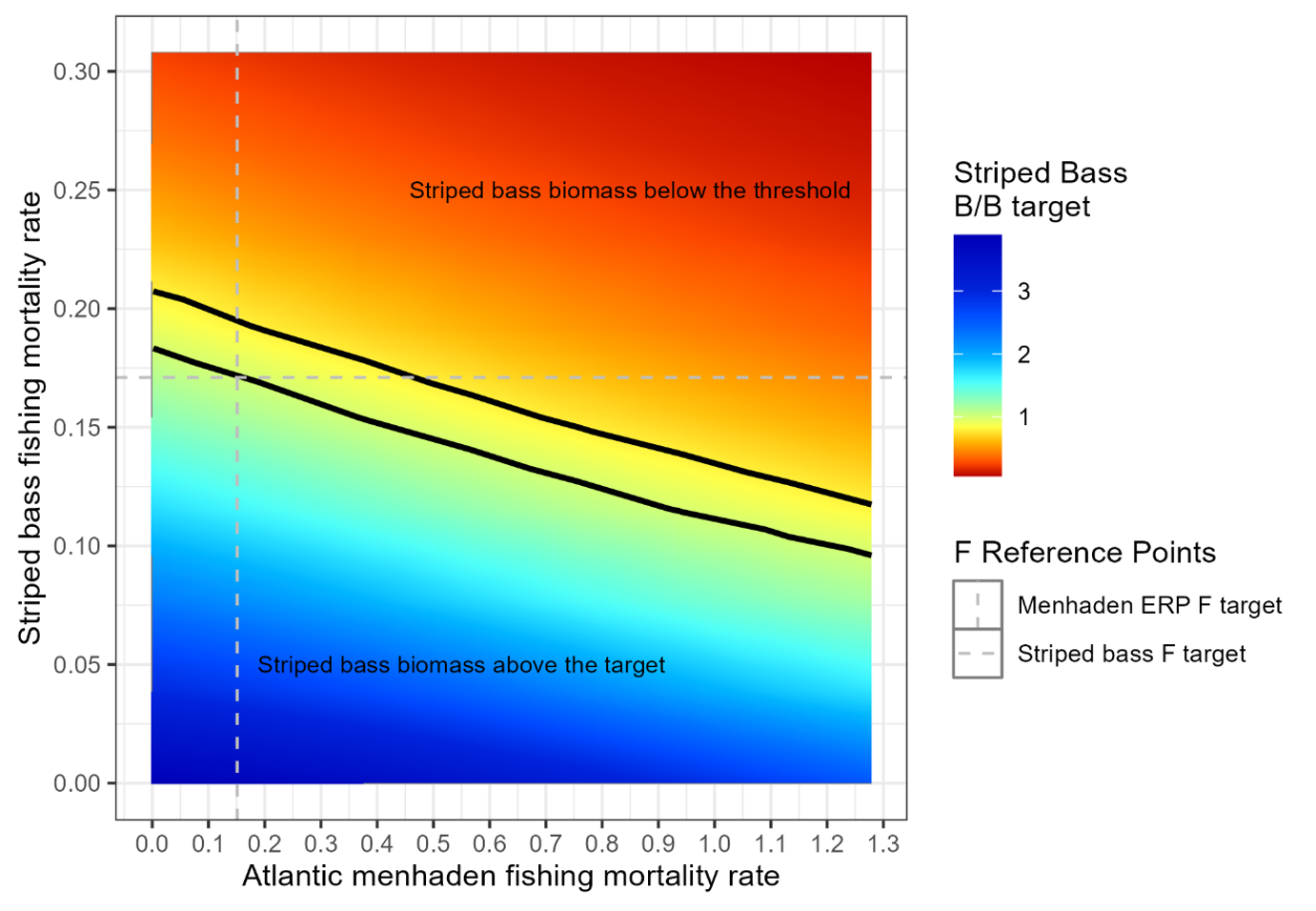
A lot of confusion has also centered on the so-called "rainbow plot" from the ERP assessment. That plot has been waved around as if it proves menhaden fishing is too high. The Technical Committee's own explanation makes clear that it shows something much more basic: for striped bass to reach their own biomass goals, striped bass fishing mortality must come down, no matter what you do with menhaden.
In simple terms, the rainbow plot is a three-dimensional picture flattened into two dimensions:
The x-axis is fishing mortality on menhaden.
The y-axis is fishing mortality on striped bass.
The colors (and the two heavy black curves) represent the third dimension: the long-term striped bass spawning stock biomass (SSB).
The Technical Committee explained that the two heavy black lines trace the combinations of striped bass F and menhaden F that would, over the long term, produce:
Striped bass at their SSB target (the lower heavy line), or
Striped bass at their SSB threshold (the upper heavy line).
A few examples from their explanation make the point very clearly:
If you set menhaden F = 0 (no menhaden fishing at all), striped bass F still must be around 0.18-0.21 to reach their SSB target or threshold.
If you allow higher menhaden F (for example, around 1.3, toward the right side of the plot), striped bass F must be even lower, around 0.10-0.13, to reach the same striped bass SSB target or threshold.
In other words, the plot is not saying, "Menhaden fishing is too high." It is saying: "For striped bass to get back to their biomass target or threshold, you must reduce striped bass fishing mortality. Cutting menhaden alone, even to zero, does not magically fix striped bass." That is perfectly consistent with what Dr. Katie Drew told the Board in 2020: you have to adjust all of them at once, and "if you don't adjust the striped bass fishing mortality nothing you do to menhaden will bring that population back." The rainbow plot is a visual representation of that same point. So, when you put the ERP framework and the rainbow plot together, the message is straightforward:
Menhaden is already being kept safely below its ERP F threshold, ensuring there is enough forage in the water and overfishing is not occurring.
The rainbow plot confirms that striped bass rebuilding hinges on striped bass management, not on ever-deeper cuts to a well-managed menhaden fishery.
Striped Bass: A Different Level of Risk-Averse Management
One piece that often gets left out of the public discussion is striped-bass and menhaden are managed with different levels of risk-averse management. At the time ASMFC adopted the ecosystem reference point (ERP) framework, striped bass was both overfished and experiencing overfishing, while Atlantic menhaden was not overfished and not experiencing overfishing. That is not a menhaden-industry talking point; it is what the Commission's own scientists told the Menhaden Board.
During the February 2020 ERP presentation, Dr. Katie Drew, the ASMFC scientist leading much of the ERP work, explained to the Board that you cannot fix striped bass simply by cutting menhaden harvest while leaving striped bass fishing mortality untouched. As she put it, the key is that "you have to adjust all of them at once. Right now, part of the reason striped bass is experiencing overfishing, and as the heat map showed, that rainbow plot showed, if you don't adjust the striped bass fishing mortality nothing you do to menhaden will bring that population back. I think we need to adjust both of them together." That is the opposite of the narrative being pushed in many press releases and op-eds. The science says:
Striped bass is overfished and has been overfished because of striped bass fishing mortality and weak recruitment.
Menhaden is not driving striped bass problems, and no amount of menhaden cuts can rebuild striped bass unless managers elect to bring striped bass fishing mortality down.
In plain language: The problem in the striped bass fishery is striped bass fishing, not a shortage of menhaden, coupled with poor recruitment, which is due to environmental factors. Yet in practice, ASMFC has applied maximum precaution to menhaden, keeping the menhaden stock safely below its ERP F threshold and maintaining very low odds of breaching biological limits, while allowing much higher risk in striped bass management, even as their own scientists have made critical suggestions for management with a 50% probability of the species being restored by 2029.
This creates a basic inconsistency:
Menhaden is being held well below its ERP F threshold (no overfishing) and above its ERP FEC threshold (not overfished), the line that tells you whether predators will have enough to eat.
Striped bass, the predator that is supposedly "protected" by cutting menhaden, has not been managed to the same conservative standard and has repeatedly exceeded its own fishing mortality benchmarks.
If you are going to claim an ecosystem-based approach, you cannot use menhaden as the only safety valve. The whole logic of the ERP model is that menhaden and striped bass are linked. That means:
You cannot run a "hyper-precautionary" policy for menhaden while tolerating high risk for striped bass and then blame menhaden for striped bass problems.
To be scientifically consistent, both species need to be managed in line with their thresholds and rebuilding plans, not just menhaden.
The bottom line is simple:
The menhaden fishery is already being managed with strong precaution below the ERP F threshold, ensuring enough forage for predators.
Striped bass management is not as risk-averse, and ASMFC's own scientists have said that without reducing striped bass fishing mortality, changes to menhaden alone cannot rebuild striped bass.
Any claim that "saving striped bass" requires massive new cuts to a well-managed menhaden fishery, while leaving striped bass management largely unchanged, is not ecosystem science, its politics dressed up as science.
How Uncertainty Is Accounted For, and Why That's Good News for Menhaden and Predators
Fisheries science is never 100% certain. That's why the menhaden framework builds layers of precaution into the system:
-
Conservative reference points
The ERP threshold itself is designed conservatively to protect predators under uncertainty.
The target is even more conservative, essentially an "ideal case" for a future, fully rebuilt predator community.
-
Probability-based decision tools
Instead of pretending they know everything exactly, scientists provide ranges of TAC options tied to different probabilities.
Managers can then choose how cautious they want to be, for example, ensuring 0% modeled probability of crossing the threshold.
-
Multiple biological safeguards
Managers don't rely on just one signal. They cross-check TAC decisions against fecundity, stock status, and other reference points.
The current TAC keeps menhaden well within safe biological limits across these measures.
The takeaway is this:
The menhaden fishery is not being pushed to the edge.
The TAC is set inside a clearly defined safety zone, with explicit buffers to account for uncertainty.
The system is constructed so that if we ever do start approaching the ERP F threshold, there are clear signals to adjust course.
Bottom Line: For anyone trying to make sense of the noise around menhaden:
No ASMFC scientist or staff member ever recommended a 50% or 54% cut to the TAC. They provided Board-requested projections with risk bands so commissioners could choose their acceptable risk; the ~54% figure came from one hypothetical scenario, not a recommendation.
That ~54% figure was a policy motion to target a 50% chance of meeting the ERP F-target, not a scientific requirement to avoid overfishing.
Management is via ERPs that protect predators (especially striped bass), and the key line is the threshold.Operating between target and threshold is normal in well-managed fisheries; the current TAC stays safely below the ERP F-threshold (avoiding overfishing) and safely above the ERP FEC threshold (not overfished).
The adopted 20% TAC (186,840 mt) is biologically conservative: 0% probability of exceeding the ERP F-threshold (no overfishing) in 2026-2028, and only 2-4% risk of dipping below the fecundity threshold, nearly indistinguishable from a ~54% cut on that metric.
ERPs are long-term, equilibrium tools. Striped bass are rebuilding with F below target, and staff noted there is "currently enough menhaden to sustain striped bass where they are right now," with rebuild possible "even under higher levels of menhaden F" in some scenarios.
Managers retain flexibility: the Board can revisit ERP targets/thresholds using the 2025 benchmark tools if objectives or conditions change.
Glossary
Models
NWACS MICE model , A model-of-intermediate-complexity ecosystem tool used to develop menhaden management advice while capturing key predator-prey dynamics.
NWACS full model , A more complex, comprehensive ecosystem model used mainly for support and sensitivity checks because of its size and data demands.
VADER , An alternative multispecies model that wasn't adopted for advice because it struggled to represent productivity ("bottom-up") effects reliably.
BAM , The single-species Atlantic menhaden stock assessment model used for status determinations and short-term projections.
Technical terms
TAC (Total Allowable Catch) , The coastwide catch cap (in metric tons) that managers set for a given period.
ERP (Ecological Reference Points) , Ecosystem-aware benchmarks (targets and thresholds) that account for predators and the broader food web to guide TAC decisions.
ERP F-target , The ecosystem fishing-mortality level on menhaden intended to keep striped bass at their biomass target (assuming bass are fished at their own F-target).
ERP F-threshold , The ecosystem fishing-mortality level on menhaden associated with striped bass staying above their biomass threshold (again assuming bass at their F-target).
F (fishing mortality) , The share of fish lost to fishing; a measure of fishing pressure.
Striped bass F-target , The long-term fishing-mortality level managers aim to apply to striped bass under normal (non-rebuilding) conditions.
Fecundity target / fecundity threshold , Benchmarks for expected egg production (long-term average) corresponding to the ERP F-target and F-threshold, respectively.
SSB target (spawning stock biomass target) , The biomass goal for mature striped bass that management aims to achieve or exceed.
Control rules / ABC framework , Risk-based guidelines that translate stock status and uncertainty into allowable catches to control the probability of overfishing.
Equilibrium (ERP context) , A long-run steady state where fishing mortality and stock size are held constant to evaluate outcomes.
"Rainbow plot" , A visual showing many combinations of striped-bass F and menhaden F that achieve different targets/thresholds, highlighting trade-offs.
Bottom-up processes , Changes in lower-trophic-level productivity (e.g., plankton/forage availability) that ripple upward to affect predator populations.
Predator-prey sensitivity (spiny dogfish-striped bass) , The model's responsiveness to assumptions about how predators (e.g., dogfish, striped bass) consume menhaden.
F rebuild , A temporarily lower fishing-mortality level applied to a stock so it can recover to its biomass target by a set deadline.
SEDAR (Southeast Data, Assessment, and Review) , The cooperative process used to develop and peer-review stock assessments.
Biomass , The total weight of fish in the water.
M (natural mortality) , The share of fish lost to non-fishing causes (predation, disease, etc.).
Recruitment , The number of young fish that survive to join the fishable population.

About the Menhaden Fisheries Coalition
The Menhaden Fisheries Coalition (MFC) is a collective of menhaden fishermen, related businesses, and supporting industries. Comprised of businesses along the Atlantic and Gulf coasts, the Menhaden Fisheries Coalition conducts media and public outreach on behalf of the menhaden industry to ensure that members of the public, media, and government are informed of important issues, events, and facts about the fishery.
Press Contact
Menhaden Fisheries Coalition
(202) 595-1212
www.menhaden.org
SOURCE: Menhaden Fisheries Coalition
View the original press release on ACCESS Newswire