
According to Omdia’s preliminary estimates, global smartphone shipments fell 20% year on year in 3Q26, a sharp acceleration from the 6% decline recorded in the previous quarter. Shipments also declined sequentially despite new flagship launches and channel preparations for the year-end festive season. Persistent memory and storage cost pressures have constrained pricing flexibility and prompted vendors to scale back shipments of low-margin devices.
This press release features multimedia. View the full release here: https://www.businesswire.com/news/home/20261015267023/en/
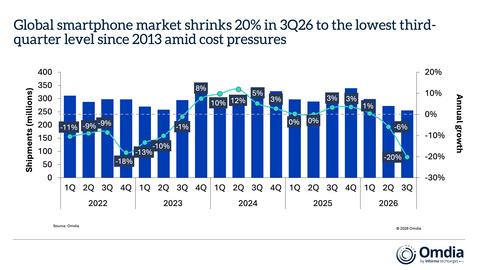
Global smartphone market shrinks 20% in 3Q26 to the lowest third-quarter level since 2013 amid cost pressures
The downturn has further polarized the competitive landscape. Samsung and Apple together accounted for 45% of global shipments, up approximately 8 percentage points from a year earlier. Their relative resilience compared with sharper declines among mass-market-focused competitors indicate that the current downturn is reshaping competitive positions.
Samsung retained the top position with a 23% market share, gaining share despite a year-on-year decline in shipments. Its broad product portfolio and established global channel presence helped cushion the impact of the market downturn, while the August launch of the Galaxy Z Fold8 and Flip8 series supported its premium positioning. Looking ahead, balancing shipment scale with portfolio profitability and premiumization will be increasingly important to sustaining Samsung's competitive position.
Apple ranked second with a 22% market share, showing strong resilience despite the wider market downturn. Continued demand for the iPhone 17 family, alongside the September introduction of the iPhone 18 Pro and Pro Max, helped maintain its momentum. The iPhone Duo marks Apple's entry into the foldable smartphone category, expanding its portfolio beyond traditional form factors and creating new opportunities to address evolving consumer needs and capture incremental demand. While AI is not yet a major purchase driver for consumers, Apple Intelligence could play an increasingly important role in differentiating Apple's user experience and sustaining its long-term ecosystem advantage.
Xiaomi maintained third position with 12% market share, followed by OPPO, including realme and OnePlus, at 9%. vivo completed the top five with an 8% share. Rising memory costs are putting pressure on profitability across price segments, with the impact particularly pronounced in more price-sensitive categories.
These pressures are forcing vendors to reassess the profitability of their entry-level portfolios and make more selective decisions about product positioning, pricing and market coverage. Vendors are prioritizing average selling price (ASP) growth and portfolio optimization to sustain shipment value and protect profitability.
“Rising component costs and differing vendor responses are reshaping the competitive landscape, but market share alone does not tell the full story,” said Hayden Hou, Principal Analyst at Omdia. “As vendors make different trade-offs between shipment scale, revenue and profitability, their performance needs to be assessed beyond unit shipments. More importantly, the strategic decisions made during this downturn could have lasting implications beyond the current cost cycle. Investments in new channel partnerships, device financing capabilities and stronger premium portfolios will help determine which vendors emerge with a more competitive and sustainable business model once cost pressures ease.”
“For vendors competing primarily on affordability, protecting profitability without sacrificing shipment scale has become an increasingly difficult balancing act,” said Lucas Zhong, Senior Analyst at Omdia. “This pressure is particularly acute in emerging markets, where consumers are more price-sensitive and vendors rely heavily on entry-level devices with already thin profit margins. However, scaling back shipments to protect margins carries long-term risks, particularly for emerging vendors, as losing market presence can weaken brand visibility and channel mindshare, which may take years to rebuild. Rather than withdrawing across the board, vendors need to make more deliberate choices about where to compete, concentrating resources on markets and products that can sustain both profitability and market relevance.”
“Looking ahead to the fourth quarter, new flagship launches, promotions and festive demand are unlikely to fully offset persistent supply-side pressures,” added Lucas. “Vendors will need to combine disciplined inventory management with more effective financing, trade-in and telco partnerships to sustain upgrades without relying on broad discounting. While shipment volumes remain under pressure, rising prices are gradually resetting consumer price expectations, potentially creating greater opportunities for higher-value devices in future replacement cycles. Vendors that can make these products more accessible and demonstrate meaningful improvements in the user experience will be better positioned for the next replacement cycle.”
Worldwide smartphone market share split
|
|||
Vendor |
3Q26 market share |
3Q25 market share |
|
Samsung |
23% |
19% |
|
Apple |
22% |
18% |
|
Xiaomi |
12% |
14% |
|
OPPO |
9% |
12% |
|
vivo |
8% |
9% |
|
Others |
27% |
29% |
|
|
|
|
|
Note: Preliminary estimates are subject to change on final release.
|
|||
ABOUT OMDIA
Omdia, part of TechTarget, Inc. d/b/a Informa TechTarget (Nasdaq: TTGT), is a technology research and advisory group. Our deep knowledge of tech markets grounded in real conversations with industry leaders and hundreds of thousands of data points, make our market intelligence our clients’ strategic advantage. From R&D to ROI, we identify the greatest opportunities and move the industry forward.
View source version on businesswire.com: https://www.businesswire.com/news/home/20261015267023/en/
“For vendors competing primarily on affordability, protecting profitability without sacrificing shipment scale has become an increasingly difficult balancing act,” said Lucas Zhong, Senior Analyst at Omdia.
Contacts
Fasiha Khan: fasiha.khan@omdia.com
Eric Thoo: eric.thoo@omdia.com
If you believe this article contains misleading, harmful, or spam content, please let us know.
Report this article