
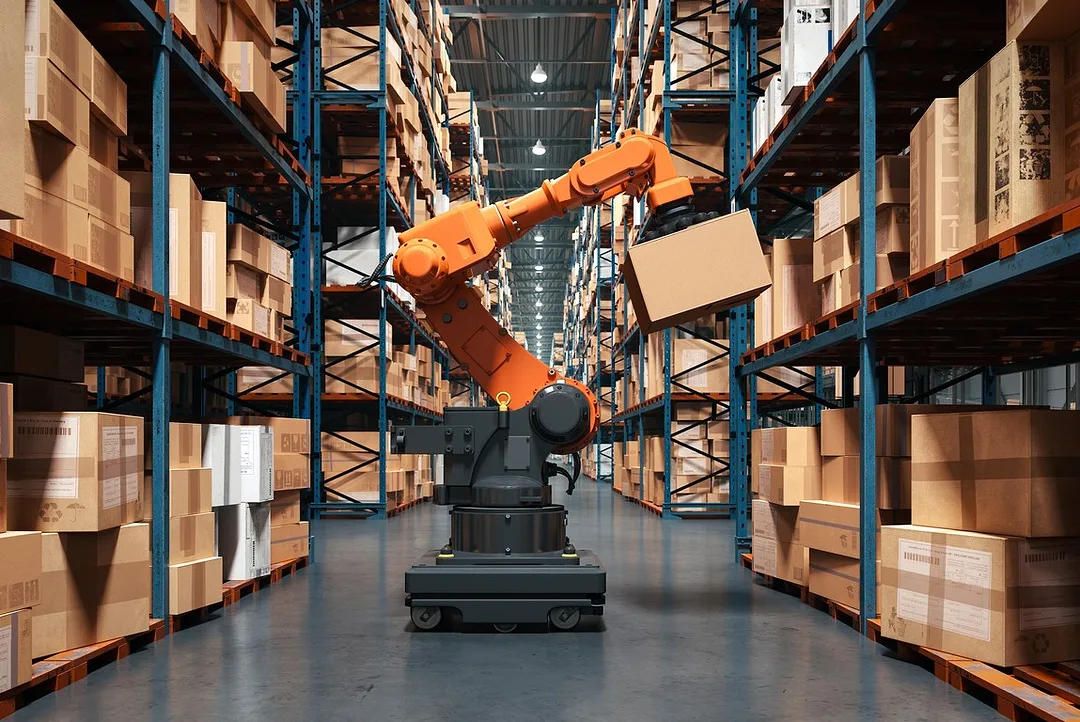
Warehouse automation is often associated with robots, conveyors, and highly mechanized fulfillment centers. In practice, automation can be much broader. Digital inventory records, barcode-based workflows, automated task allocation, real-time stock updates, and system-generated alerts can all reduce repetitive manual work without requiring a warehouse to become fully autonomous.
For business leaders, the case for automation should therefore begin with operational needs rather than technology. A modern warehouse management system can provide the digital foundation to improve inventory visibility, standardize workflows, and support automation as warehouse requirements become more complex.
The question is not whether every warehouse should automate everything. It is where automation can produce enough operational value to justify its cost while preserving the flexibility needed for future growth.
Understanding the Real Cost of Warehouse Automation
Automation requires investment, and the purchase price of technology is only one consideration.
Businesses may need to account for software implementation, equipment, integration with existing systems, employee training, process redesign, maintenance, and ongoing support. More advanced physical automation can also require changes to warehouse layouts or infrastructure.
For this reason, evaluating warehouse automation solely on expected labor savings can produce an incomplete business case.
Leaders should consider the operational problem being addressed. Is inventory becoming difficult to locate? Are employees repeatedly entering the same information? Are picking errors creating additional work? Is warehouse growth increasing administrative complexity? Are existing processes unable to provide reliable inventory visibility?
A useful investment case connects automation expenditure to specific operational constraints.
Warehouse automation creates the most value when it solves a defined workflow problem, not when technology itself becomes the objective.
Efficiency Starts With Better Information
Some of the most important warehouse efficiency improvements are digital rather than mechanical.
Manual inventory records can create delays between a physical warehouse event and the information available to the rest of the organization. If an item is received, moved, picked, or dispatched without the corresponding record being updated promptly, employees may make decisions using outdated information.
Warehouse management software can help structure these activities so inventory movements are recorded more consistently. Barcode scanning and other identification technologies can further reduce reliance on employees manually typing product information.
Better inventory tracking gives teams clearer information about what stock is available and where it is located.
That visibility can reduce time spent searching for goods, investigating discrepancies, or checking multiple records before completing a task. It also provides a stronger foundation for more advanced automation because automated processes depend on reliable operational data.
Comparing Manual and Automated Warehouse Workflows
Automation does not affect every warehouse activity in the same way. Some tasks remain highly dependent on employee judgment, while repetitive and predictable processes may be better candidates for technology support.
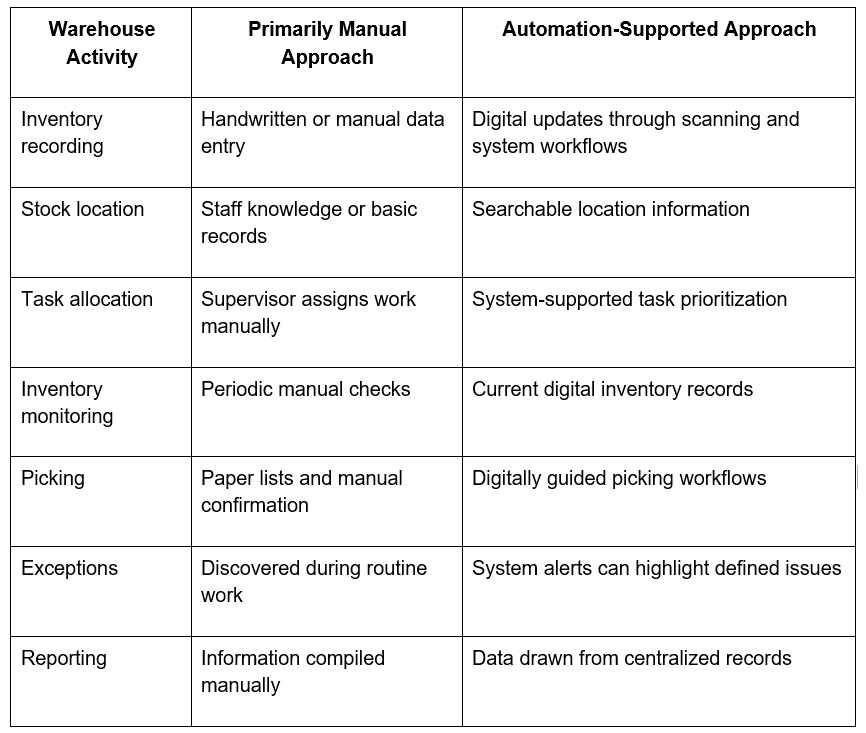
The objective is not to remove employees from warehouse operations. It is to determine which routine activities can be handled more consistently by technology and which require human expertise.
Reducing Repetitive Work Can Improve Operational Capacity
Warehouse employees perform many activities that directly contribute to the movement and control of inventory. They may also spend considerable time on administration.
Repeated data entry, paper-based checking, manual status updates, and searching for inventory information can consume capacity without physically moving goods closer to the customer.
Automation can reduce some of this administrative friction.
For example, scanning an item as it moves through a defined warehouse process can update its digital record without requiring someone to enter the same information later. Automated workflows can also present employees with relevant tasks or information, rather than requiring supervisors to coordinate every routine action individually.
This does not mean automation eliminates the need for warehouse teams. Employees remain essential for managing damaged stock, unusual orders, discrepancies, safety issues, equipment problems, and other exceptions.
The business case is stronger when automation allows people to spend less time on repetitive administration and more time on operational work that benefits from human judgment.
Scalability Changes the Automation Calculation
A warehouse process that works at one level of activity may become difficult to sustain as order volumes, inventory ranges, or operating locations expand.
Manual systems often scale by adding more administrative effort. More inventory means more records to maintain. More orders mean more picking documentation. More employees can mean additional coordination between teams and shifts.
Warehouse automation can help reduce the extent to which administrative workload grows alongside physical activity.
A cloud-based warehouse management system, for example, can provide a common environment for inventory tracking and standardized processes. As operations expand, the business can apply established digital workflows rather than creating separate spreadsheets or informal procedures for each new area.
Scalability should still be evaluated carefully. Technology needs to support the warehouse's expected requirements without forcing the organization into unnecessary complexity.
Inventory Visibility Has Value Beyond the Warehouse
Warehouse automation can also improve the quality and availability of information used outside warehouse operations.
Purchasing teams need to understand stock availability. Customer service employees may need information about whether goods are ready for fulfillment. Operations leaders may want to identify recurring bottlenecks, while finance teams need reliable inventory information for planning and control.
Centralized warehouse data can provide these functions with a more consistent operational picture.
Improved inventory visibility does not guarantee perfect stock accuracy. Physical counts, appropriate procedures, employee training, and exception management remain necessary. However, digital inventory tracking can make discrepancies easier to identify and investigate.
This broader informational value should be considered when evaluating automation, as warehouse performance affects more than just the warehouse itself.
A Phased Approach Can Control Automation Costs
Warehouse automation does not need to begin with a large-scale transformation.
Businesses can start by identifying processes where manual work creates the greatest operational friction. Digital inventory management, barcode scanning, standardized receiving, guided picking, or automated notifications may provide logical starting points depending on the warehouse.
Once those workflows are established, organizations can evaluate whether more advanced automation is justified.
A phased approach also allows employees to adapt to new processes and gives managers opportunities to assess whether technology is solving the intended problems before expanding it further.
This can be particularly important for growing businesses that need greater warehouse capacity but may not require extensive physical automation.
Measuring the Business Case Beyond Labor Reduction
The return from warehouse automation should be assessed across several operational dimensions.
Labor utilization matters, but leaders should also consider inventory visibility, process consistency, picking accuracy, order handling capacity, administrative workload, exception management, and the ability to scale operations.
Not every benefit can be reduced to a single financial measure. Better inventory information, for example, may support faster operational decisions across several departments.
Businesses should therefore establish clear objectives before implementation and monitor whether the automated process is delivering the expected operational improvements.
Building Automation Around the Warehouse Strategy
Warehouse automation is most effective when it supports a broader operational strategy.
Technology should make inventory easier to track, routine processes easier to execute, and warehouse information easier to use. It should also give employees better tools rather than adding unnecessary complexity to their work.
For some organizations, that may mean beginning with warehouse management software and digital inventory workflows. Others may eventually justify more extensive equipment and physical automation as throughput and complexity increase.
The strongest business case is not based on automating the greatest number of tasks. It is based on selecting the right level of automation for the warehouse's current challenges and future requirements.
By balancing implementation costs with efficiency, inventory visibility, employee capacity, and scalability, businesses can treat warehouse automation as a practical operational investment rather than technology adopted for its own sake.